Free Solar Panel Scheme 2026: What’s Real and What’s a Sales Pitch
Search for a free solar panel scheme and you’ll find two very different things. One is real: council-run grants that fully fund solar panels for some low-income households. The other is a sales pitch dressed up as a government offer. This guide shows you how to tell them apart, who can still get free solar panels in 2026, and what everyone else can do to cut the cost.
Is there a free solar panel scheme in 2026?
Yes, but it’s narrower than most adverts suggest. There is no single national free solar panel scheme that anyone can apply for. Fully funded solar is now mainly delivered through the Warm Homes: Local Grant, which councils in England run as part of the government’s Warm Homes Plan.
The older route, ECO4, is in its final phase. The government extended its end date to 31 December 2026, but many energy suppliers stopped taking new ECO4 applications earlier this year. If someone tells you in late 2026 that they can “get you on ECO4”, ask them which supplier is funding the job and when the work will be finished.
For most homeowners, the honest answer is this: solar panels won’t be free, but they can be a lot cheaper than people expect, thanks to 0% VAT, low-cost government-backed loans and lower panel prices.
Who qualifies for the free solar panel scheme?
The Local Grant is the main free solar panel scheme left in England. Each council sets its own rules and has its own budget, so check with yours. In general, councils look at three things:
- Your home’s energy rating. The grant targets less efficient homes, usually EPC band D to G.
- Your household income or benefits. Councils commonly look for a household income of around £36,000 or less, someone receiving a means-tested benefit, or a home in a qualifying low-income postcode area.
- Your tenure. Owner-occupiers and private renters (with the landlord’s agreement) can apply. Council and housing association homes are covered by separate social housing funding.
The grant is based on a retrofit assessment of the whole home. That means solar panels may be offered alongside insulation or heating upgrades, or the assessor may decide another measure should come first. Funding can also run out locally, so some councils close to new applications partway through the year.
To check, search for “Warm Homes Local Grant” plus your council’s name, or call your council’s energy or housing team. You never need to pay anyone to apply.
What a free solar panel scheme normally covers
When a household does qualify, the funding usually covers:
- A survey of the roof and the home’s energy use
- Solar panels, an inverter and the mounting kit
- A home battery, where the assessment shows it makes sense
- Scaffolding, installation, electrical sign-off and registration with your network operator
Work funded this way has to be fitted by an MCS-certified installer, which is also what you’ll need later to earn export payments.
“Free solar panels” offers to be careful with
Not every free offer is a grant. These are the ones that catch people out.
Rent-a-roof deals
Popular in the 2010s, these put panels on your roof for nothing, but a company owns them and keeps the payments for 20 to 25 years. You get some free daytime electricity. The catch is the lease on your roof, which has caused problems for people selling or remortgaging their homes. If you’re offered one, read the lease in full before you sign.
Cold calls and “government-approved” claims
Be wary if someone calls, knocks or messages you out of the blue saying you’ve been “selected” for a free solar panel scheme. Real grants come through your council or an installer the council works with. Warning signs include:
- Being asked to pay a fee to “process” or “secure” a grant
- Being promised you definitely qualify before anyone has checked your details
- Pressure to sign on the day because “funding ends this week”
- No company name, address or phone number you can check
“Free” with a catch in the small print
Some offers advertise free panels but add costs for the inverter, scaffolding or “admin”. Others are really finance agreements at a high interest rate. Ask for a fixed, written quote that shows every cost before you agree to anything.
Don’t qualify for a solar grant? The next best options
Most households won’t qualify for fully funded panels. These are the ways to bring the cost down.
1. 0% VAT until 31 March 2027
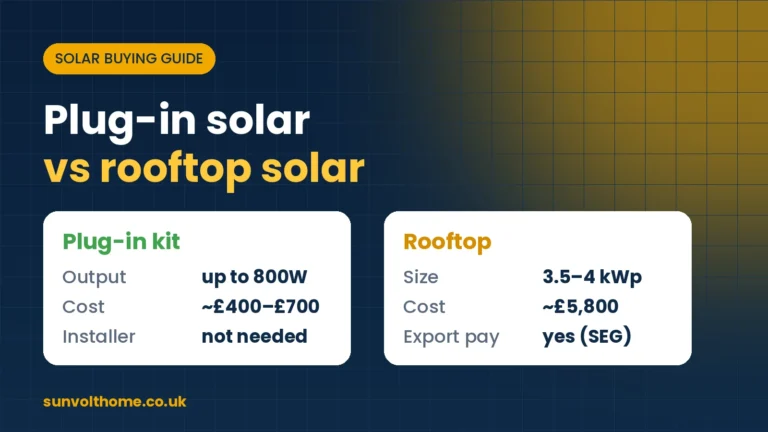
Solar panels and home batteries fitted in homes are zero-rated for VAT until 31 March 2027. After that, the rate is due to go to 5%. On a typical system, that difference can be several hundred pounds. The relief applies when an installer supplies and fits the system, not to kit you buy and fit yourself. Read more in our guide to VAT on solar panels and batteries.
2. The Warm Homes Loan Scheme
The government-backed Warm Homes Loan Scheme opened in late October 2026. The government supports participating lenders so they can offer lower rates than a normal personal loan, and some offer 0% interest. Loans for solar panels and batteries each have their own cap, and you’ll still need to pass the lender’s credit check. Our guide to government-backed solar loans explains what the repayments could look like, and our Warm Homes Loan page covers how to apply.
3. Earn money with the Smart Export Guarantee
Under the Smart Export Guarantee, energy suppliers pay you for the solar power you send to the grid. Rates vary a lot between suppliers, so it’s worth comparing. You’ll need an MCS certificate and a smart meter that records exports.
4. Add a battery to use more of your own power
Without a battery, much of the power from your panels is generated while you’re out. A home battery stores it for the evening, which usually saves more than exporting it. See our solar battery storage guide to work out whether it’s worth it for your home.
Free solar panel scheme vs loan vs paying upfront
Here’s how the main routes compare, so you can see which one fits your situation.
- Free solar panel scheme (Warm Homes: Local Grant). You pay nothing, up to the council’s funding cap. It suits low-income households in homes rated EPC D to G. The catch is limited council budgets and strict eligibility.
- Warm Homes Loan. You make monthly repayments, often at a reduced rate. It suits homeowners who want solar now but would rather spread the cost. You’ll need to pass a credit check.
- Paying upfront. You pay the full installed price, with 0% VAT until 31 March 2027. It suits households with savings who want the fastest payback, but the cost on day one is bigger.
If you’re unsure which route applies, start by checking the grant. If you don’t qualify for a free solar panel scheme, compare the loan and upfront costs using the same written quote.
What solar panels can save you without a grant
Savings depend on the size of the system, which way your roof faces, how much electricity you use during the day and whether you have a battery. Rather than rely on a headline figure, use our solar payback calculator with your own bill, or read our breakdown of solar panel costs in the UK.
Not sure how big a system your roof can take? Our guide on how many solar panels fit on your roof walks you through it.
How to check if a free solar panel scheme could apply to you
- Find your EPC rating. Search “find an energy certificate” on GOV.UK and enter your postcode.
- Check your council. Look up whether your council is running the Warm Homes Local Grant and if it’s still taking applications.
- Look at your bills. Note your yearly electricity use in kWh. You’ll find it on your annual statement or your supplier’s app.
- Get a fixed quote. A proper survey should give you one written price, with no pressure to sign on the day.
Free solar panel scheme FAQs
Do I need to be on benefits to get free solar panels?
Not always. Many councils also accept households on a low income or living in a qualifying postcode area, as long as the home has a low EPC rating. Rules vary, so check with your council.
Is the free solar panel scheme the same as ECO4?
No. ECO4 was funded by energy suppliers and is ending on 31 December 2026. Fully funded solar now comes mainly through the Warm Homes Local Grant, run by councils.
Will a free solar panel scheme include a battery?
Sometimes. Batteries can be funded where the home assessment shows they help, but they aren’t automatic.
Do I need planning permission for solar panels?
Most homes don’t, because rooftop solar usually counts as permitted development. Listed buildings and some conservation areas are different. Our guide to planning permission for solar panels has the details.
What if I don’t qualify for a grant?
You can still cut the cost with 0% VAT before April 2027, a Warm Homes loan, export payments and a well-sized system. Many households find that’s enough to make solar pay for itself, even without a free solar panel scheme.
Get an honest answer for your home
At Sunvolt Home we fit solar panels and home batteries across the North East and Yorkshire. We’ll tell you straight whether a grant is likely for your home, and if it isn’t, what solar would actually cost and save. Every free home survey takes about an hour, comes with one fixed written quote and carries no obligation.
Book your free home survey or call us on 0330 057 7202.