Power Cut Protection at Home: Will a Solar Battery Keep the Lights On?

Here is something that surprises a lot of people with solar panels: when the grid goes down, so do they. A standard solar system switches itself off in a power cut, even at midday in July. That is a safety rule, not a fault. Real power cut protection needs a battery and an inverter that can run part of your home on its own.
This guide explains how home battery backup actually works, what it can and cannot run, how long it lasts, and whether it is worth it for a house in the North East or Yorkshire. If you already know you want it, our battery backup and power cut protection page covers how we design and fit it.
Why solar panels switch off in a power cut
Grid-connected inverters are built to disconnect the moment they lose the mains signal. If they kept pushing power into the street, they could energise a cable that engineers believe is dead. So the inverter shuts down, and your panels sit there in the sunshine producing nothing you can use.
A battery on its own does not fix this either. Many batteries are installed purely to store cheap or spare electricity, and they shut down with everything else unless the system has a backup function and the wiring to match.
How power cut protection with a battery works
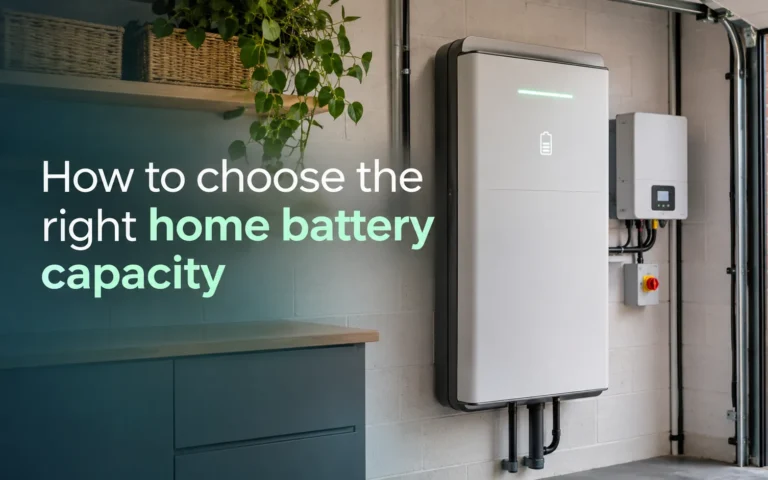
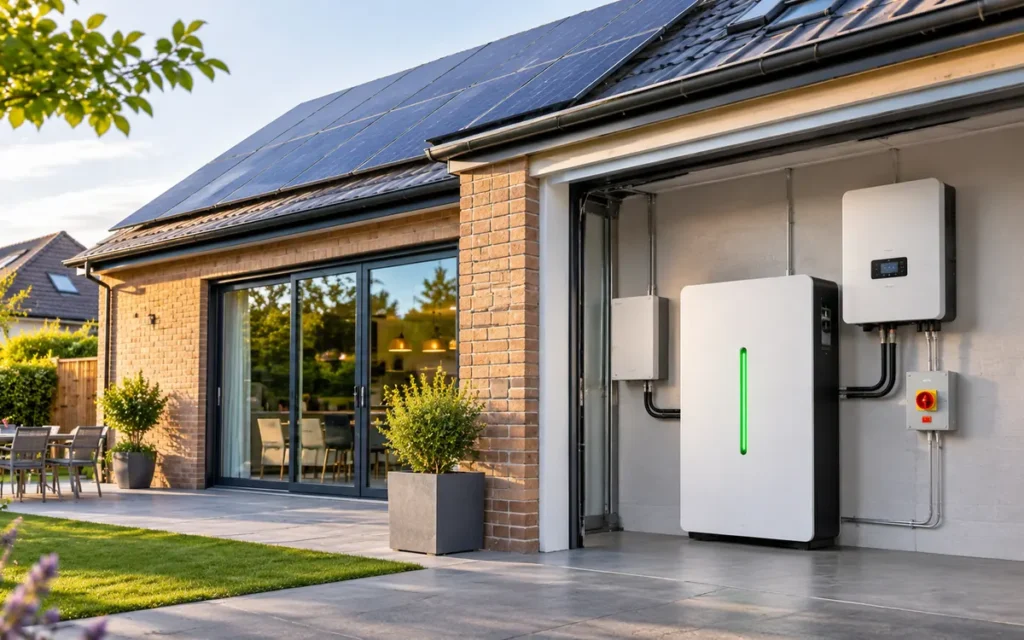
Battery backup needs three things working together: a hybrid inverter or backup gateway that can isolate your home from the grid, a battery with enough stored energy, and a set of circuits wired to receive backup power.
When the supply drops, the system detects it, separates your home from the network, and switches the chosen circuits over to the battery. On some systems this happens fast enough that a router barely notices. Others take a few seconds, and a simpler “EPS” setup may only power one dedicated socket. Ask exactly which type you are being quoted, because the difference matters on a dark January evening.
In daylight, a well-designed system can keep recharging the battery from your panels during the outage. That is what turns a few hours of backup into something closer to days, if the cut drags on.

Whole-home backup or essential circuits?
Most homes are better off backing up the essentials, not everything. An electric shower can pull 8 to 10 kW, and an oven or kettle can drain a battery quickly. Backing up a short list of circuits makes the battery last far longer.
A typical essentials list looks like this:
- Lighting circuits
- Fridge and freezer
- Wi-Fi router and a phone-charging socket
- Gas boiler controls and pump (most modern boilers will not run without electricity)
- A medical device, sump pump or alarm, if your home has one
How long will battery backup last?
It depends on what you run and how much the battery holds. A rough worked example: a fridge-freezer, LED lights, a router, phone charging and a gas boiler’s pump might average around 300 W between them. A battery with 5 kWh of usable capacity would cover that for roughly 16 hours with no solar top-up. Double the usable capacity and you roughly double the time.
That is an illustration, not a promise. Check the wattage of your own appliances, and remember that batteries keep some charge in reserve to protect themselves. Our guide on choosing home battery capacity goes through sizing in more detail.
Do homes in the North East really need power cut protection?
Most power cuts are short. Ofgem’s review of Storm Arwen found 82% of customers were back on within 24 hours. The same storm, though, left nearly a million homes in Britain without power in November 2021, and nearly 4,000 were off for more than a week. Northern Powergrid, the network operator for much of the North East and Yorkshire, was among the companies Ofgem criticised. The full findings are in Ofgem’s Storm Arwen report.
So the honest answer is that battery backup is not essential for everyone. It earns its place if you work from home, live rurally on an overhead line, rely on a medical device, or simply never want to sit through another cold night without heating. For most people, it is a bonus on a battery they would want anyway for cheaper energy. Our guide on how solar and battery storage work together explains the day-to-day savings side.
Battery backup vs a generator
A petrol or diesel generator is the old answer to power cut protection, and it still has a place on farms and remote properties. For a typical home, a battery wins on almost every day-to-day point. It switches over automatically, makes no noise, needs no fuel stored in the shed, and earns its keep the rest of the year by storing cheap or solar electricity.
A generator does win on one thing: it can keep running for as long as you have fuel. If you live somewhere that loses power for days at a time, the strongest setup is often a battery for instant cover plus solar to recharge it, rather than a generator you have to start in the rain.
Common mistakes with home battery backup
Assuming any battery gives backup. Plenty do not. It has to be designed and wired for it.
Backing up the whole consumer unit by default. An electric shower or immersion heater can empty a battery in an hour.
Forgetting the boiler. Without its controls on a backup circuit, a gas boiler will not heat the house in a cut.
Not testing it. Ask your installer to show you a simulated outage at handover, so you know what stays on.
Frequently asked questions
Do solar panels work during a power cut?
Not on their own. Standard grid-tied solar systems shut down when the grid fails, for the safety of network engineers. To keep using solar power in a power cut, you need a battery and inverter set up for backup, with circuits wired to receive it.
What should I do when the power goes off?
In Great Britain, call 105 to report a power cut or get an update from your network operator. If someone at home relies on electricity for medical equipment, sign up to the free Priority Services Register, explained by the Energy Networks Association.
How much does battery backup cost?
It depends on battery size and how much of the home you back up. Backup wiring adds some cost over a standard battery install. Home batteries are currently zero-rated for VAT until 31 March 2027, according to HMRC. Our solar panel cost guide gives typical system prices.
Can I add power cut protection to my existing solar panels?
Often, yes. A battery with a hybrid inverter or backup gateway can usually be added to an existing system. A survey checks your inverter, consumer unit and roof generation first.
Plan your backup before the next storm
Winter is when power cuts bite hardest, and it is also when solar generates least, as our guide to solar panels in a North East winter explains. That makes a well-sized battery and a sensible backup circuit list more important, not less. If you live in the North East or Yorkshire, book a free battery survey and we will show you exactly what your power cut protection would keep running.