Choosing a home EV charger: 7 simple things to check

A home EV charger is the most convenient way to keep an electric car topped up. You plug in when you get home, and the car is ready in the morning. But chargers are not all the same, and the right one depends on your car, your electrics, your parking and whether you have solar panels.
This guide covers what to check before you buy, in plain English, so you can talk to an installer with confidence.
Why get a home EV charger at all?
You can charge from a normal 3-pin socket, but it is slow and not designed for hours of heavy use every night. A dedicated home EV charger is faster, safer and smarter. Most home units charge at up to 7kW, which adds roughly 25 to 30 miles of range per hour. A 3-pin plug manages around 8.
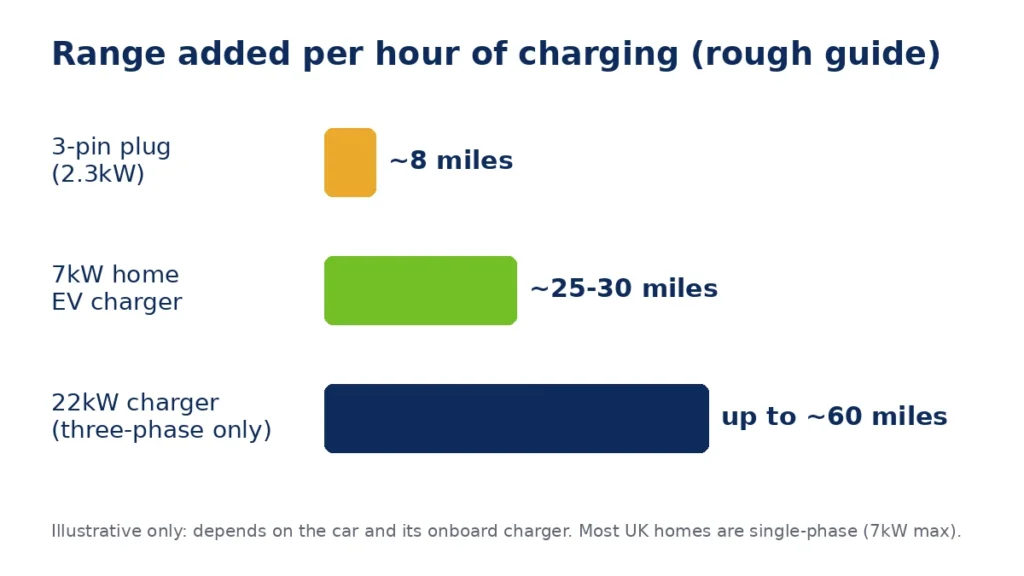
Faster 22kW chargers exist, but they need a three-phase supply, which very few UK homes have. Many cars can only take 7kW or 11kW on AC charging anyway, so a 22kW unit often brings no real benefit at home.
Tethered or untethered
A tethered charger has a cable permanently attached, so you just plug in. An untethered charger has a socket and you use your own cable, which can look tidier and suits households with different cars.
Tethered is more convenient day to day. Untethered gives you flexibility if you change car, and the cable can be locked away. Neither is better in general. Think about how often you will plug in and whether anyone else will use the charger.
Smart features that matter
Chargers sold for home use in Great Britain must be smart and meet the smart charge point regulations. In practice, that means an app, scheduling and default off-peak charging.
When comparing models, look at:
- The app. Is it easy to set a schedule, check sessions and see costs?
- Tariff integration. Some chargers work directly with EV tariffs, so the car charges at the cheapest times automatically.
- Solar mode. A solar-aware home EV charger can use surplus solar electricity that would otherwise be exported.
- Load management. The charger slows down if the rest of the house is using a lot of power, so you do not overload the supply.
Your electrical supply
An installer checks your incoming supply, main fuse rating, consumer unit and earthing arrangement. Some homes need a consumer unit upgrade or load management so the charger does not overload the supply when other appliances are running.
Earthing matters more than most people realise. Many UK homes have a type of supply where a rare fault could make the car’s bodywork live, so modern chargers include built-in protection or the installer adds an earth rod. Ask how your installer handles this. Your installer should also notify your local network operator, which is a normal step for a home EV charger.
Cable route and location
The distance from the consumer unit to your parking space and the wall construction affect the installation time and cost. Groundworks may be needed for detached garages or long runs.
Think about where you actually park. The charger should reach the car’s charging port without the cable stretching across a path. A wall next to the driveway is usually ideal. Off-street parking is normally required, because running cables across a pavement is not allowed without permission from the council.
Using a home EV charger with solar panels and a battery
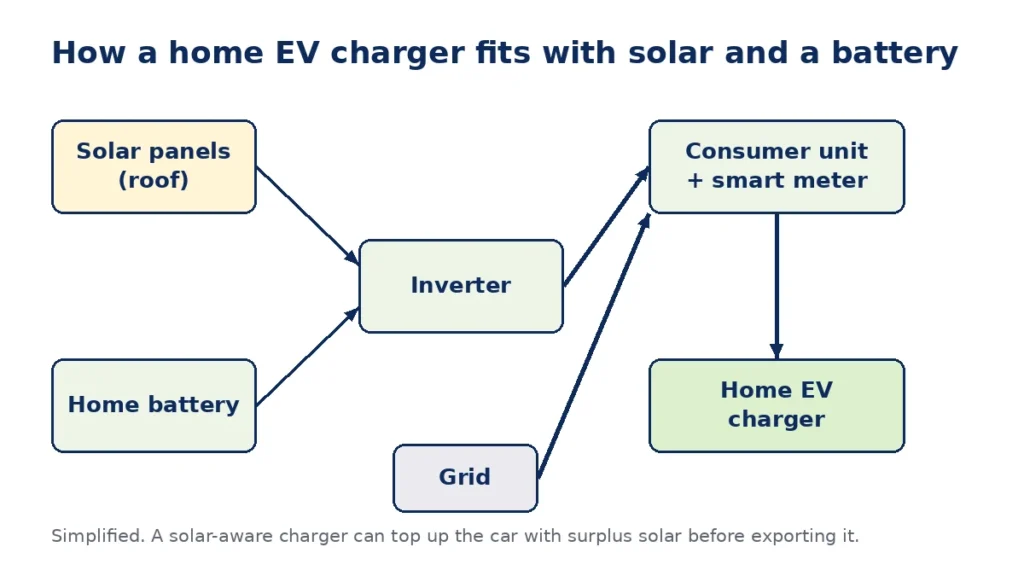
If you have, or plan to have, solar panels, a home EV charger becomes even more useful. On a sunny day, a solar-aware charger can put spare generation into the car instead of exporting it for a few pence. On cloudy days or overnight, it can charge on a cheap off-peak rate.
A home battery adds another layer. It can store daytime solar for the house in the evening, while the car charges overnight at the low rate. Some households find this combination cuts both their home bills and their motoring costs. Results depend on your mileage, your tariff and your roof, so treat any savings claim with caution until you have seen the numbers for your home. Our solar payback calculator gives a rough starting point.
If you are planning both, tell your solar installer about the car early. It can affect the inverter choice and how big an array is worth fitting.
Costs and funding
Prices vary with the charger, the cable run and any electrical upgrades, so ask for a fixed written quote after a survey. Watch out for very low headline prices that exclude common extras such as an earth rod or longer cable runs.
Government grants for chargers are now mainly aimed at people who live in flats or rent. The GOV.UK chargepoint grant for renters and flat owners page has the current rules and amounts. Homeowners in houses usually pay for the charger themselves, although government-backed loans can help spread the cost of solar panels and batteries that pair well with it.
Home EV charger checklist
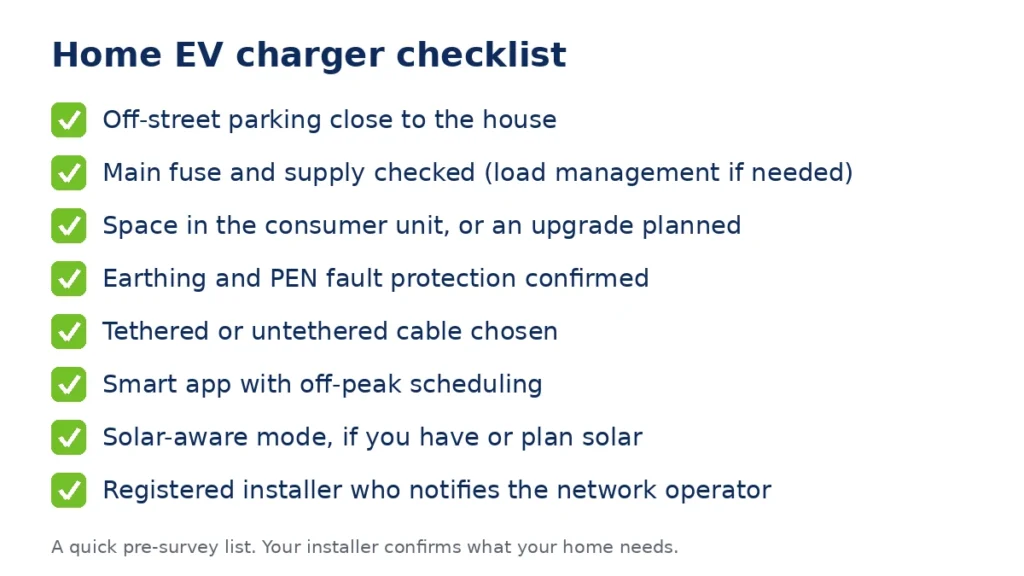
Before you choose a home EV charger, run through this list:
- Do you have off-street parking close to the house?
- Has your main fuse and supply been checked, with load management if needed?
- Is there space in the consumer unit, or is an upgrade planned?
- Has the installer confirmed how earthing and fault protection will be handled?
- Have you chosen tethered or untethered?
- Does the app support scheduling and your preferred tariff?
- Do you want a solar mode now or in future?
- Is the installer qualified, and will they notify the network operator?
Get two quotes, compare what is included, and do not feel rushed. A home EV charger should last many years, so it is worth taking a week to get it right.
Frequently asked questions
How long does it take to install a home EV charger?
A straightforward installation is often done in half a day. Longer cable runs, groundworks or a consumer unit upgrade can add time.
Can I install a home EV charger if I rent?
Usually, yes, with your landlord’s permission. Renters may also be able to get a government grant towards the cost.
Will a home EV charger work with my solar panels?
Any charger will use solar power when the panels are generating, but a solar-aware model can prioritise surplus solar automatically, which makes better use of it.
Do I need a smart meter?
Not to install the charger, but most cheap EV tariffs need a smart meter, so it is worth getting one if you want low overnight rates.